


 Switch to Ireland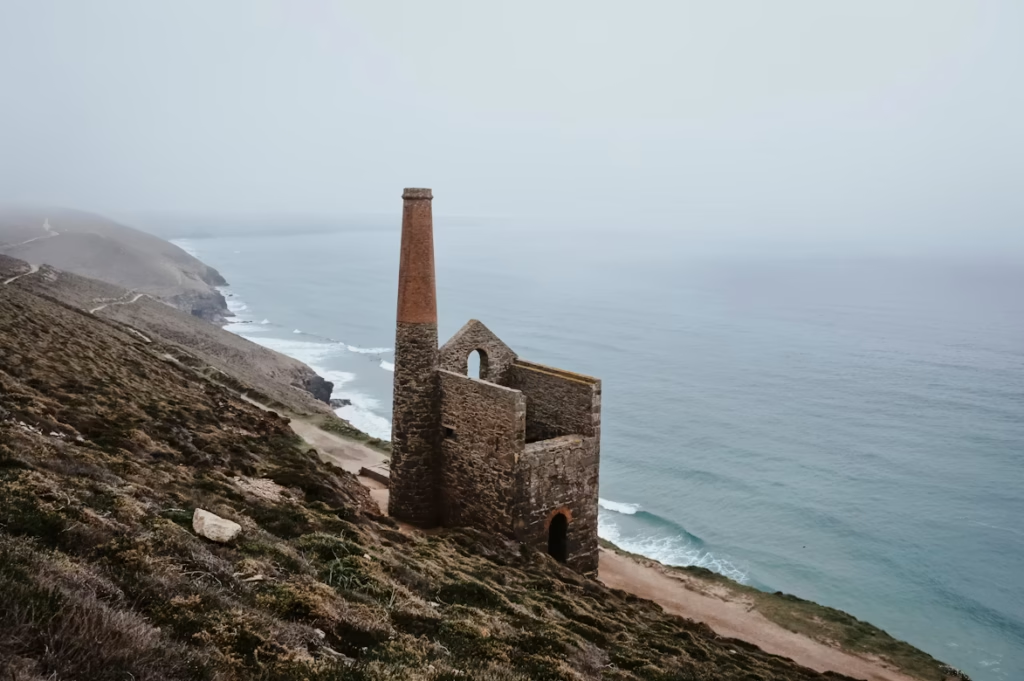
A Brief History of Lead Mining in Cornwall
When people think of Cornish mining, tin and copper tend to dominate the story. Lead plays a smaller part in the county’s history, but it is a significant one. The mines that produced it were, for a short period, among the most productive in Britain.
The Geology Cornwall’s Lead Mining
Cornwall’s mineral wealth has a straightforward geological explanation. As the granite that forms much of the peninsula cooled millions of years ago, fissures opened in the rock and mineral-rich materials crystallised within them, forming lodes of tin, copper, zinc and lead. Because these ore-bearing rocks formed in fissures rather than as sedimentary deposits, they run vertically rather than horizontally, which meant each lode required its own separate mine shaft.
Lead ore in Cornwall takes the form of galena, a dense grey sulphide mineral. In Cornwall, galena occurs in veins alongside zinc sulphide and other sulphide minerals, and Cornish galena had one particularly valuable characteristic: it almost always contained silver. That silver content would prove to be the making, and in some cases the undoing, of Cornwall’s lead mines.
Lead in the Shadow of Tin
Lead was never Cornwall’s primary metal. In 1839, the geologist De La Beche ranked lead mining below even manganese in terms of economic importance to the county. The county’s identity was bound up with tin and copper; lead was a secondary consideration, worked where the lodes appeared but rarely the main object of a mining venture.
That changed dramatically in the 1840s. Two districts in particular came to define Cornish lead production: the area around Newlyn East in mid-Cornwall, and Menheniot in the east of the county.
Significant Cornish Lead Mine Locations
East Wheal Rose
Lead was first discovered at East Wheal Rose, near the village of St Newlyn East, in 1812. The mine was formally established in 1834, and by 1846 it employed over 1,200 men, women and children. At its peak it was one of the largest lead mines in England.
The site sat in a natural bowl, surrounded by hills, which made it productive but also vulnerable. On 9 July 1846, a freak downpour sent water cascading down from the surrounding hillsides into the mine workings. Despite efforts by the workforce to divert the flow, the water broke into the shafts and within a short time 39 men and boys had lost their lives. It remains one of the worst disasters in Cornish mining history.
The mine was pumped out and back in production within months. Between 1845 and 1885, East Wheal Rose produced 48,200 tons of 62% lead ore, along with 212,700 ounces of silver and 280 tons of zinc ore. A mineral railway connecting the mine to Newquay was opened in 1849 to carry ore to the coast for shipping. The engine house that housed the pumping equipment still stands today, near the Lappa Valley Steam Railway.
Menheniot
Further east, the parish of Menheniot experienced its own lead boom. In 1843, a road digger near the church exposed a shallow lode of lead ore, and the discovery set off a rush that would transform the area. The population of the parish soared by almost 60 per cent in the 1840s as workers arrived to work the new mines.
The most productive of these was Wheal Mary Ann. Worked from 1843 to 1875, it produced 30,000 tons of galena and over a million ounces of silver. Peak production years ran from 1857 to 1872, after which rising costs, falling mineral prices and declining yields made the mines unviable. By the mid-1870s, what had been a busy industrial village was emptying out again.
West Chiverton
The last great chapter in Cornish lead mining belongs to West Chiverton, near Perranzabuloe. The mine first opened in 1846 under the name Ventongimps Mine, closed after three years, and was restarted in 1856 as West Chiverton. By 1871 it was employing 838 people.
Between 1859 and 1886, West Chiverton produced around 45,800 tons of lead ore, containing over 33,000 tons of lead and more than 1.24 million ounces of silver. At the peak of its output in 1870, the mine produced 3,582 tons of lead estimated to contain over 160,000 ounces of silver, around 45 ounces per ton. The lead and silver revenues were roughly equal in value, each contributing around £40,000 annually.
The success of West Chiverton prompted a wave of speculative ventures in the surrounding area, with neighbouring operations borrowing the Chiverton name in hopes of attracting investors. Few delivered on the promise, and the history of the satellite mines includes several instances of misfortune and financial sharp practice.
The End of the Cornish Lead Mining Industry
Falling lead prices in the 1870s and 1880s brought the industry to a close. The same global market forces that had already depressed copper and tin mining swept through lead as well. By the mid-1880s, most of Cornwall’s lead mines had shut, and the communities that had grown up around them either moved on or shrank back to their pre-boom size.
The legacy of those decades is still visible in the landscape. Engine houses, capped shafts and spoil tips remain across the parishes of Perranzabuloe, Menheniot and Newlyn East, listed today within the Cornwall and West Devon Mining Landscape World Heritage Site.
Lead Then, Lead Now
There is a thread connecting Cornwall’s lead mining past to the lead working trades of today. The galena extracted from those Cornish lodes was smelted into sheet lead and used in construction across Britain: roofing, flashings, gutters, rainwater goods. The material itself has not changed. Lead remains the durable, malleable, recyclable metal it always was, still specified for the same applications for which Cornish miners were digging it out of the ground 150 years ago.
At Leadworx, we manufacture roofing lead products in Cornwall from 100% recycled lead, produced to BS EN 12588. The industry has changed; the county, and the material, endure.
